Barbie, Curtain, Horseshoe, Pie, Tulip: The Five Vulva Shapes and Their Stories
The five vulva shape names everyone has seen on a chart, what each one describes, how to find yours with a mirror, and the surprising truth about where the names come from: not ancient folklore but a bikini waxer in 2017. Plus the much older stories of cultures that praised the vulva, from a Sumerian goddess singing about her own body to the laughter that brought back the spring.

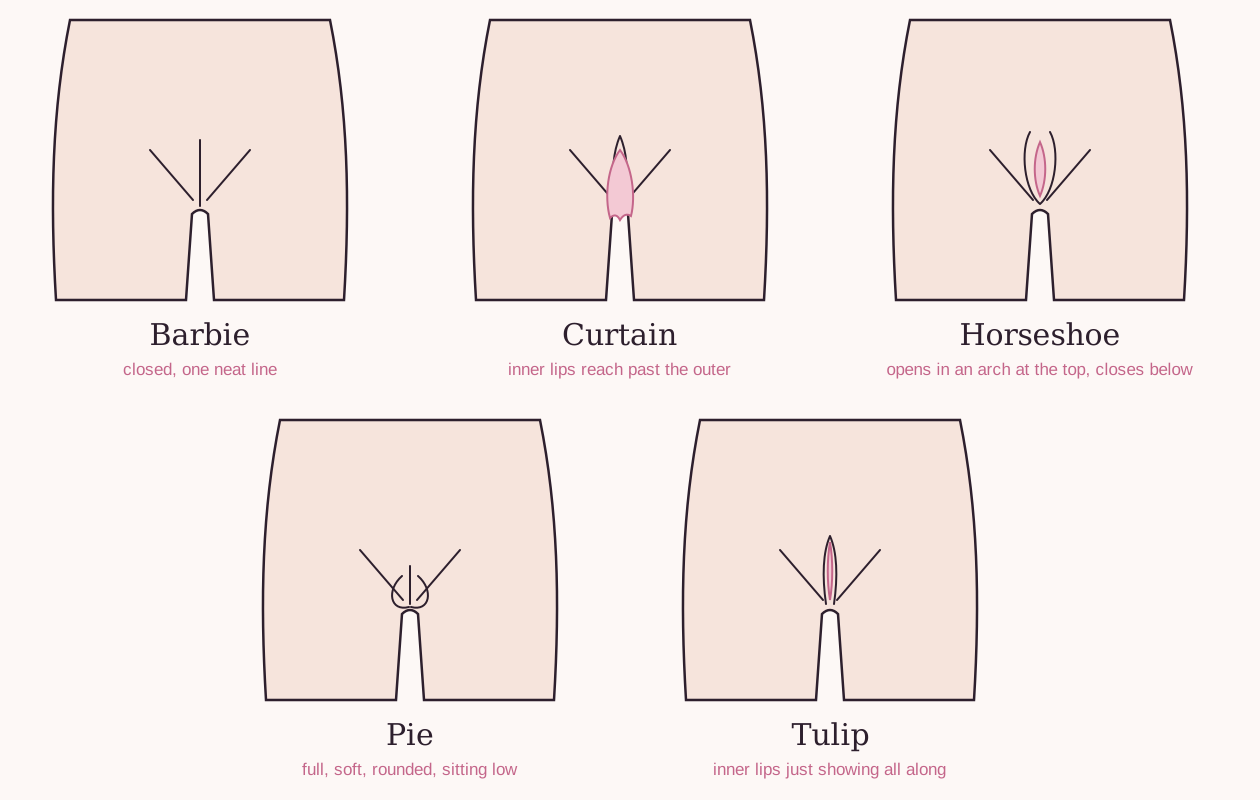
Barbie, Curtain, Horseshoe, Pie and Tulip are five names for how the inner and outer lips of the vulva sit together. Barbie: the inner lips fully hidden. Curtain: the inner lips reaching past the outer ones. Horseshoe: open at the top, closed below. Pie: hidden inner lips with soft outer lips sitting low. Tulip: the inner lips showing slightly all along. They are affectionate everyday pictures, not grades, and most women find themselves somewhere between two.
What are the five vulva shapes?
- Tulip. Inner lips showing gently along their whole length, like a bud about to bloom.
- Curtain. Inner lips extending past the outer lips; in other languages, the butterfly and the flamenco.
- Horseshoe. Outer lips arching open at the top and meeting below.
- Pie. Inner lips hidden, outer lips soft, rounded and a little low; first called puffs.
- Barbie. Inner lips fully contained, only the outer lips showing; also called the closed eye.
How do I find my shape?
Standing, with a hand mirror held low, or sitting with your knees apart and the mirror between them. Look at the outer lips, the inner lips, and where each sits in relation to the other. You are allowed to be between two names; most people are, and the two sides often differ. Then ask two questions. Do the inner lips show at all? If not, you are a Barbie or a pie, depending on how the outer lips sit. If they do, do they show all along (tulip), only at the top (horseshoe), or reach past the outer lips (curtain)? The two sides often answer differently, which is part of what makes every vulva its own.
Where do the names come from?
Not from ancient folklore, which surprises most people. The five names, Barbie, Curtain, Horseshoe, Puffs and Tulip, come from a 2017 Elite Daily interview with a former bikini waxer known only as Mel, who had seen more vulvas at work than most doctors. She was clear about what the list was for: "This isn't a mathematic algorithm." Every vulva, she said, "shares a sisterhood with all other vaginas, and nobody should feel strange or abnormal." Within days the list was on BuzzFeed, and within a couple of years it had been translated into Russian, Spanish, Portuguese and German.
"Pie" is a small mystery solved along the way: Mel's "puffs" became Russian puff-pastry words, слойки and слоёный пирожок, and came back into English as pie. Spanish and Portuguese lists added their own names for the curtain, the butterfly and the flamenco, and called the Barbie the closed eye.
Because the names are so new, no personality folklore has grown up around them; we searched in several languages and found none, and this series does not invent any. What each article offers instead is the real, older story behind the image each name borrows: the lotus-bud behind the tulip, the butterfly behind the curtain, horseshoe luck, pastry nicknames, and a doll.
Which cultures have praised the vulva?
Many, and long before 2017.
About four thousand years ago, in a Sumerian song preserved on clay, the goddess Inana praises her own body in language of pure pride, as translated by the University of Oxford's Electronic Text Corpus of Sumerian Literature: "this moored Boat of Heaven ...... of mine, clothed in beauty like the new crescent moon". A goddess, singing, unembarrassed.
In India, the yoni has long been a sacred symbol, standing for the divine eternal process of creation and regeneration, and the lotus, which appears throughout Indian temple art, is one of its symbols.
In Greek myth, when the goddess Demeter was frozen with grief for her lost daughter, a woman named Baubo made her laugh by lifting her skirt, and the laughter broke the spell. The story survives in sources going back to the fourth century BCE. In medieval Ireland and Britain, the carved figures called sheela-na-gigs, displaying themselves boldly, were often placed over doors and windows; one theory holds that they were there to protect the building.
That is the real tradition behind any list of vulva shapes: not a ranking, but a very long history of people finding this part of the body powerful, sacred, protective, funny and beautiful.
Is one shape better than another?
No. The lists say so themselves: Mel's own words were that nobody should feel strange or abnormal. None of the five is the finished version of the others. The Barbie is named after a doll with no anatomy; the curtain is the most common shape on the list; the tulip, the horseshoe and the pie sit happily between. If you arrived here worried rather than curious, start with Are My Labia Normal? The Honest Answer. This series is about names and stories, and it assumes the thing that article explains: every shape here is simply a shape.
For a completely different way of naming the same variety, a framework built on animals and a wheel of directions, see The Nine Types, and How They Fit Together.
The short version
Five affectionate names from a waxer's list in 2017, describing how inner and outer lips sit together. No personality folklore exists for them, but the images they borrow carry real old stories, and the vulva itself has been praised by goddesses, temples and myths for four thousand years.
Sources
- Elite Daily, These Are The 5 Types Of Vaginas, According To A Former Bikini Waxer (2017) - where the five names come from.
- Electronic Text Corpus of Sumerian Literature, A balbale to Inana and Dumuzid - Inana's song.
- Wikipedia, Yoni - the yoni and the lotus.
- Wikipedia, Baubo - Demeter's laughter.
- Wikipedia, Sheela na gig - the carvings over doors and windows.
Comments
Loading comments...