The Tulip Vulva: A Bud About to Bloom
The tulip is the vulva shape where the inner lips show slightly all the way along, held within the outer lips like the petals of a bud about to open. Where the name comes from, how to recognise it, and the long, lovely history of comparing the vulva to a flower, from the lotus-bud of an Indian classic to Georgia O'Keeffe, who said her flowers were only flowers.
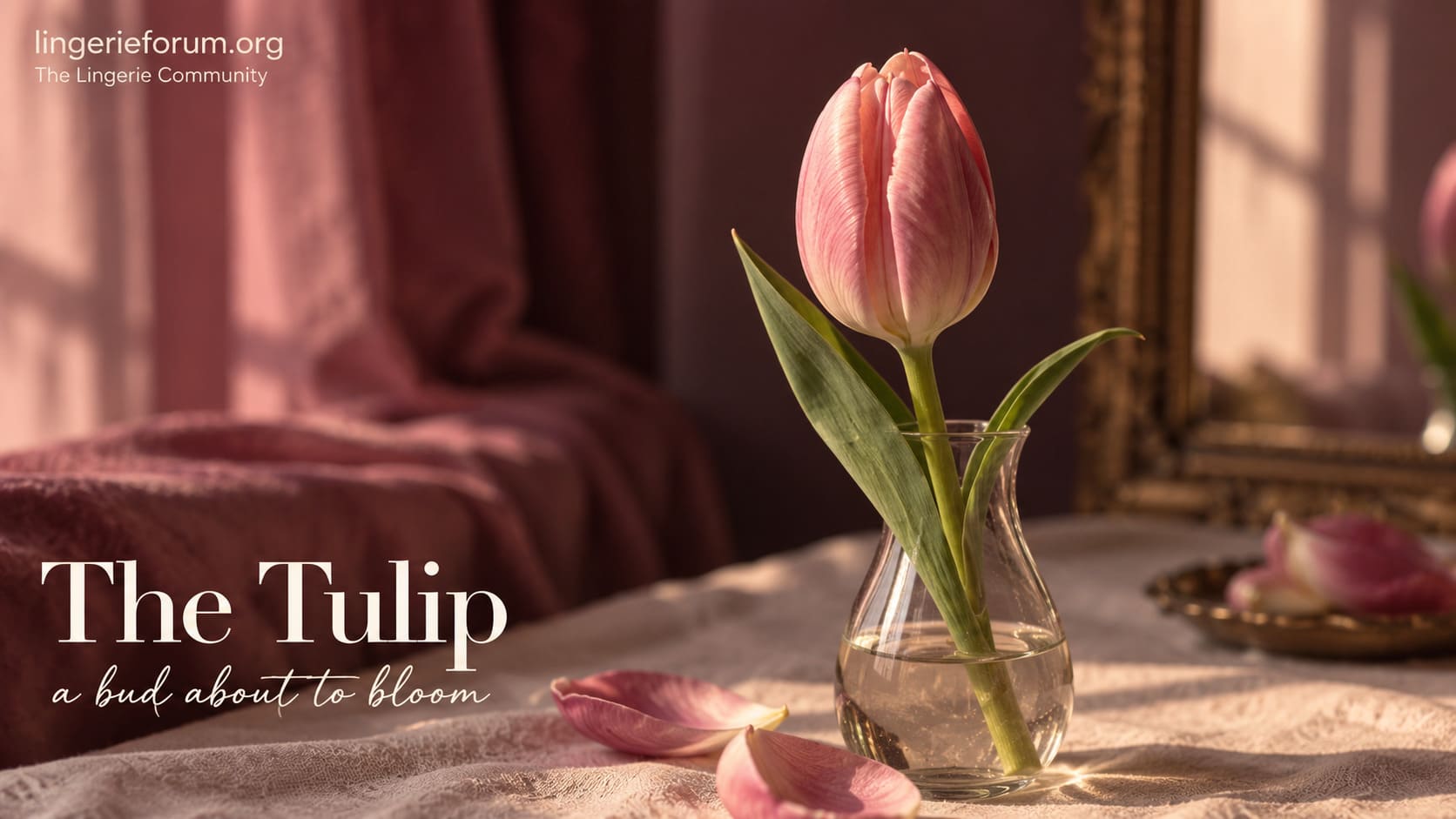
The tulip is the vulva shape where the inner lips show a little along their whole length, held softly within the outer lips, the way the edges of the petals show on a tulip that is just about to open. It is one of the five names on the most widely shared list of vulva shapes, and it is the one with the prettiest history behind it.
What does a tulip vulva look like?
The outer lips are there and rounded, and the inner lips are visible just slightly between them, from top to bottom, rather than only in one place. Nothing about it is half-way to anything else; it is a complete shape in itself, the way a tulip bud is a whole flower and not an unfinished one.
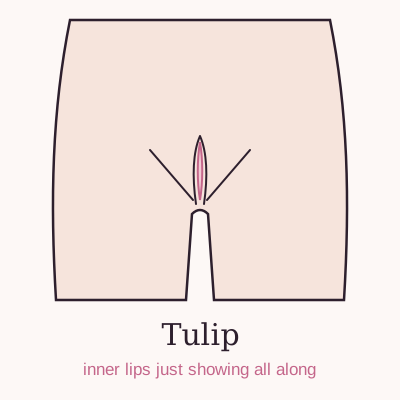
How do I know if mine is a tulip?
Standing, with a hand mirror held low, or sitting with your knees apart and the mirror between them. Look at the outer lips, the inner lips, and where each sits in relation to the other. You are allowed to be between two names; most people are, and the two sides often differ. If the inner lips show gently all the way along, you are looking at a tulip. If they show more at the top and meet again below, that is the horseshoe. If they reach past the outer lips, that is the curtain.
Where does the name come from?
The five names, Barbie, Curtain, Horseshoe, Puffs and Tulip, come from a 2017 Elite Daily interview with a former bikini waxer known only as Mel, who had seen more vulvas at work than most doctors. She was clear about what the list was for: "This isn't a mathematic algorithm." Every vulva, she said, "shares a sisterhood with all other vaginas, and nobody should feel strange or abnormal." Within days the list was on BuzzFeed, and within a couple of years it had been translated into Russian, Spanish, Portuguese and German. Mel described the tulip as looking like a flower bud about to bloom, and the name has travelled intact: Tulpe in German, tulipán in Spanish, тюльпан in Russian.
Why is the vulva so often compared to a flower?
Because people have been doing it, affectionately, for a very long time.
In India, the lotus has long stood beside the yoni as its symbol: the lotus is described as an alternate symbol for yoni that is commonly found in Indic arts, an icon found in temples. The Ananga Ranga, a fifteenth- or sixteenth-century Indian love manual by Kalyana Malla, describes its most celebrated type of woman, the Padmini or Lotus-woman, in exactly these terms. In Richard Burton's 1885 translation of the Ananga Ranga: "Her Yoni resembles the open lotus-bud." Five centuries before anyone said tulip, somebody said lotus-bud, and meant it as the highest praise the book could give.
In the twentieth century, the comparison went the other way. Critics, beginning with her husband Alfred Stieglitz, read Georgia O'Keeffe's huge painted flowers as vulvas. She disagreed, firmly, for the rest of her life. As she put it in 1939, people "hung all your own associations with flowers on my flower and you write about my flower as if I think and see what you think and see of the flower - and I don't." Which is its own lesson: a flower can be read as a vulva, and a vulva can be read as a flower, and the person who owns it gets the last word.
What does the folklore say about tulip women?
What the folklore says. Honestly: nothing about personality. We searched in English, Russian, Spanish and German, and nobody has attached character traits to the tulip, or to any of the five names. They are only a few years old. What the tulip inherits instead is the far older flower tradition above: the lotus-bud of the Ananga Ranga, the lotus of Indian temple art, and every poet who ever reached for a petal. If the tulip has a meaning, it is that one: something beautiful, just opening.
If you arrived here worried rather than curious, start with Are My Labia Normal? The Honest Answer. This series is about names and stories, and it assumes the thing that article explains: every shape here is simply a shape. For a different way of naming the same variety, a framework built on animals rather than flowers, see The Nine Types, and How They Fit Together.
The short version
Inner lips showing gently all along, held within the outer ones: a bud about to bloom. The name is from 2017; the compliment is five centuries older, and a lotus-bud before it was ever a tulip.
Sources
- Elite Daily, These Are The 5 Types Of Vaginas, According To A Former Bikini Waxer (2017) - where the five names come from.
- Wikipedia, Yoni - the lotus as a symbol of the yoni in Indic art.
- Richard Burton's 1885 translation of the Ananga Ranga - the Padmini, or Lotus-woman.
- Wikiquote, Georgia O'Keeffe - her 1939 words on her flowers.
Comments
Loading comments...