What Does Your Mouth Shape Say? Face Reading, Honestly
Upturned, downturned, straight, wide, small, or resting slightly open: the mouth shapes face reading names, how to find yours in a mirror, what decides a mouth's shape (teeth, age and time), where the character claims come from (a classical Chinese text, Lavater, Wells), and what decades of research say about reading personality from a face.
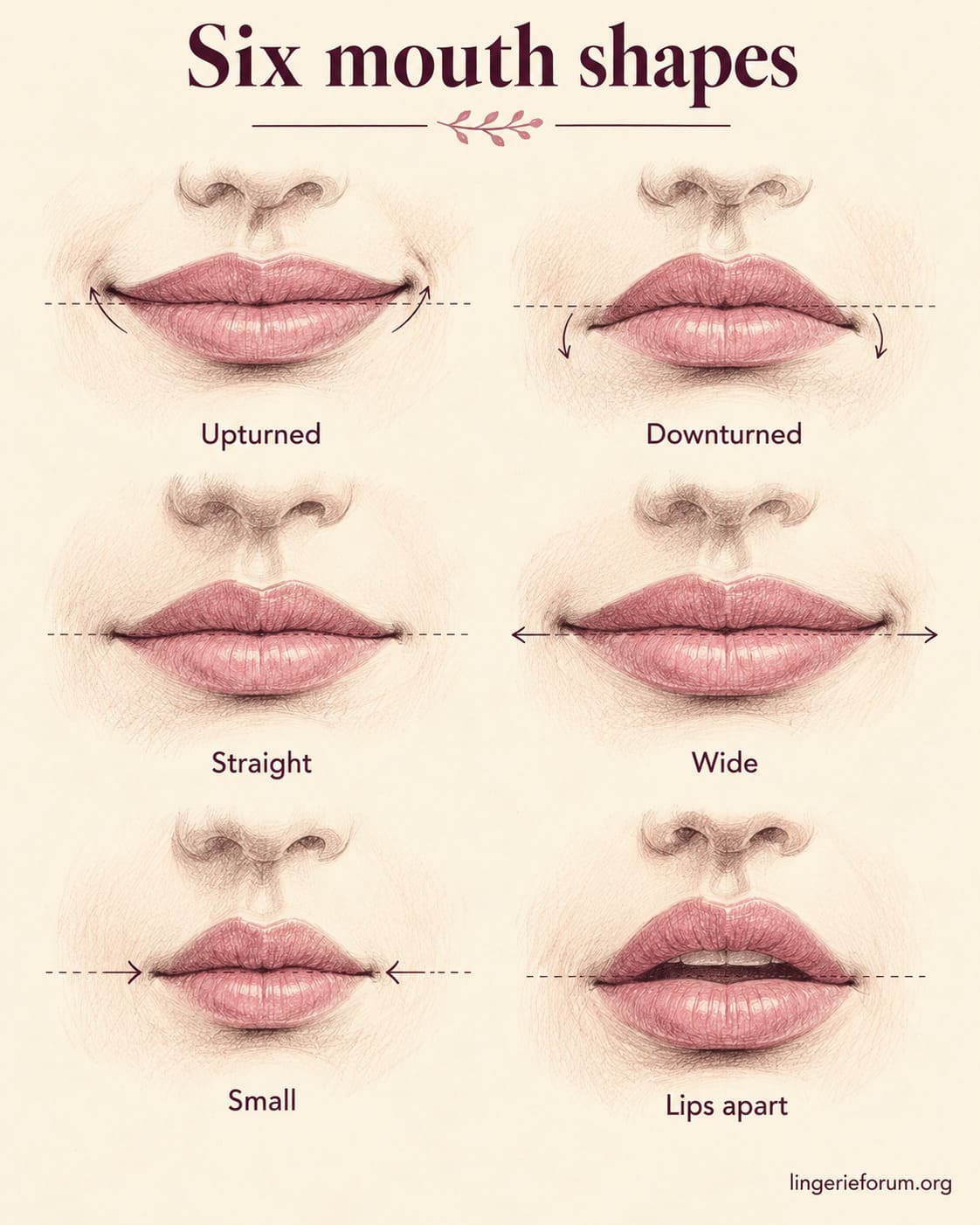
Face reading sorts mouths by three things: which way the corners sit at rest (up, level or down), how wide the mouth is relative to the eyes, and whether the lips meet or rest apart. That gives the six shapes below, plus one idea underneath them all: that a mouth reveals character. The shapes are real and easy to see in a mirror. The character claims are folklore, and this series says so every time.
What are the mouth shapes in face reading?
- Upturned corners. Corners slightly above the lip line at rest: the crescent moon mouth.
- Downturned corners. Corners slightly below: the overturned-boat mouth, and the shape most often misread as sadness.
- Straight. Level corners and an even close: the four-character and square mouths.
- Wide. Corners reaching the line down from the pupils or beyond: the tiger and dragon mouths.
- Small. Corners well inside that line, often with full lips: the cherry or rosebud mouth.
- Lips apart at rest. A mouth that rests slightly open.
And one article that is not about a shape at all: Why Does My Resting Face Look Sad, Cross or Bored?, on why strangers read moods into a face at rest.
For the lips themselves, their fullness and the cupid's bow, see Lip Shapes Explained.
How do I find my mouth shape?
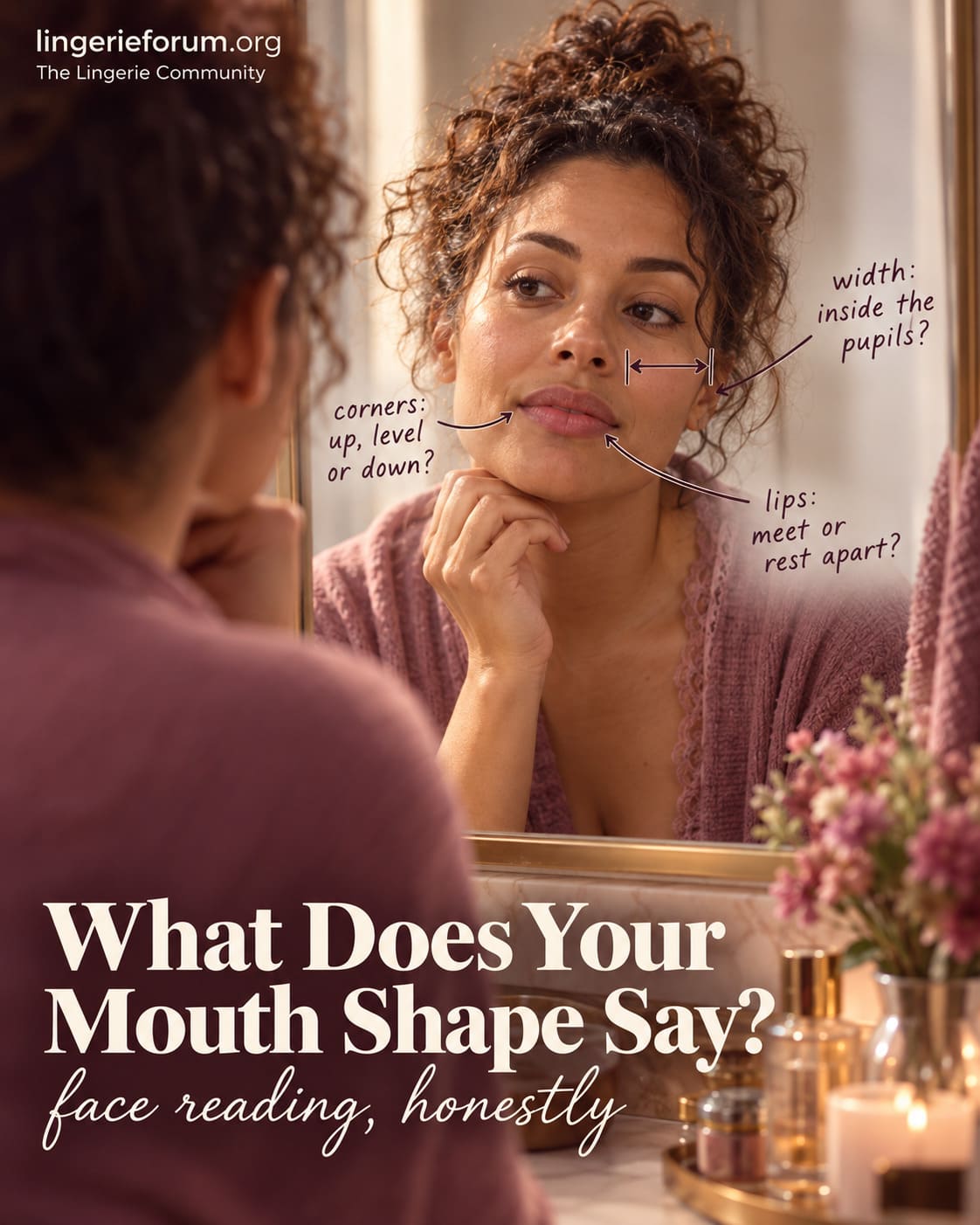
Relax your face completely, lips together but not pressed, teeth apart, and look straight into a mirror at eye level, or take a photo with the camera held level. Do not smile first and then stop; a mouth coming down from a smile sits higher than it does at rest.
Then ask three questions. Corners: above, on or below an imaginary line through where your lips meet? Width: do the corners sit inside, on or outside a line dropped from the centre of each pupil? Rest: do your lips meet, or rest a little apart? Most people find their two corners disagree slightly, which is ordinary. And most people land between two shapes rather than squarely in one.
What decides the shape of a mouth?
Mostly the structure behind it and time. Mouth width follows the teeth: forensic scientists estimate it from the distance between the upper canines, which performed statistically best among the methods one study tested. Age moves everything: in a 3D study of adult lips, philtrum and cutaneous upper lip height and area, lip width, and angles related to cupid's bow significantly increased, whereas vermilion height and mouth corner angles decreased. Corners sit lower, lips grow wider and thinner, and the skin above the lip lengthens, for everyone.
So your mouth shape at twenty-five and at sixty-five may be two different entries in a face-reading book, with the same person behind both.
Where does face reading of the mouth come from?
Three traditions describe mouths, and they rarely agree. Ma Yi Xiang Fa, a classical Chinese face-reading text traditionally credited to a legendary figure known as the Hemp-Robed Daoist, names sixteen mouths and gives each a verdict about fortune. Johann Caspar Lavater's Essays on Physiognomy, published in German in the 1770s and quoted here from Thomas Holcroft's English translation, reads character from lips and corners. Samuel R. Wells's New Physiognomy, from 1866, does the same with the confidence of its century. Modern face-reading pages mix all three, usually without saying so.
The classical Chinese material is worth describing accurately, because modern pages rarely do. Ma Yi Xiang Fa illustrates sixteen mouths, many named after animals, and gives each a short verse. The verses are about fortune: whether a person will be rich, hold office, live long. Several are cruel. The gentle personality readings found on today's websites are a later layer that nobody signed.
Lavater and Wells did write about character, in confident sentences that have not aged well.
Can your mouth shape reveal your personality?
No. No study we could find has tested any named mouth type. Research on the wider claim, that faces reveal character, has found people agree quickly about what a face "says" and are mostly wrong. A review from Alexander Todorov's lab concluded that the diagnostic validity of these attributions has been greatly overstated. A 2022 meta-analysis of trustworthiness judgements from faces found accuracy unlikely to be of practical utility. One study built a prediction model for exactly this and reported that it fails to reliably infer personality traits from either facial features or first impressions.
So why does the folklore persist? Partly because it is fun, and partly because beliefs about faces can manufacture their own evidence. In one experiment, impressions passed along a chain of people ended up with more trustworthy looks associated with more trustworthy behavior - even when there was no relationship between looks and behavior at the start of the chain.
When is a change in the mouth a medical matter?
A shape you have always had is not a symptom. A sudden change is. The NHS lists face weakness, where one side of your face may droop and it might be hard to smile, as a sign of stroke: call 999. A drooping corner of your mouth can also be Bell's palsy, which needs urgent medical help. Sudden and one-sided means now.
The short version
Six shapes from three questions: corners, width, and whether the lips meet. Teeth and time decide most of it. The character readings come from a classical Chinese text about fortune, two confident Europeans and a great deal of anonymous repetition, and the research says faces do not reveal personality in any useful way. Enjoy the folklore as folklore.
Sources
- Houlton, Jooste and Steyn 2020, Mouth width and cupid's bow estimation - read as an abstract.
- Yang et al. 2023, Gender- and age-related characterization of lip morphology - read as an abstract.
- Wolffhechel et al. 2014, predicting personality from faces - read as an abstract.
- Uddenberg et al. 2023, on how face-trait beliefs spread - read as an abstract.
- NHS, Stroke symptoms
- NHS, Bell's palsy
- Todorov et al. 2015, Social attributions from faces - the accuracy of reading character from faces, read as an abstract.
- Foo et al. 2022, Accuracy in facial trustworthiness impressions: a meta-analysis - read as an abstract.
- Ma Yi Xiang Fa, section on the mouth (Chinese) - the sixteen classical mouths.
- Lavater, Essays on Physiognomy, Holcroft translation - "The Mouth and Lips".
- Wells, New Physiognomy (1866) - chapter XI, on the mouth.
Comments
Loading comments...