The Small Mouth: Cherry Mouths, Rosebud Mouths and Folklore That Cannot Decide
A narrow mouth, often with full, rounded lips: the cherry mouth of Chinese face reading and the rosebud mouth of English. What the shape is, why width follows the teeth, and why the small mouth has the most contradictory folklore of any shape, brilliant in one line of the same classical text and poor in the next.

A small mouth is one whose corners sit well inside an imaginary line dropped from the centre of each pupil. It often comes with full, rounded lips, which is the combination Chinese face reading calls the cherry mouth and English has long called a rosebud mouth. Like every mouth width, it follows the architecture behind it, and like every mouth shape it has attracted centuries of confident verdicts. In this case the verdicts cannot even agree within a single book.
What does a small mouth look like?
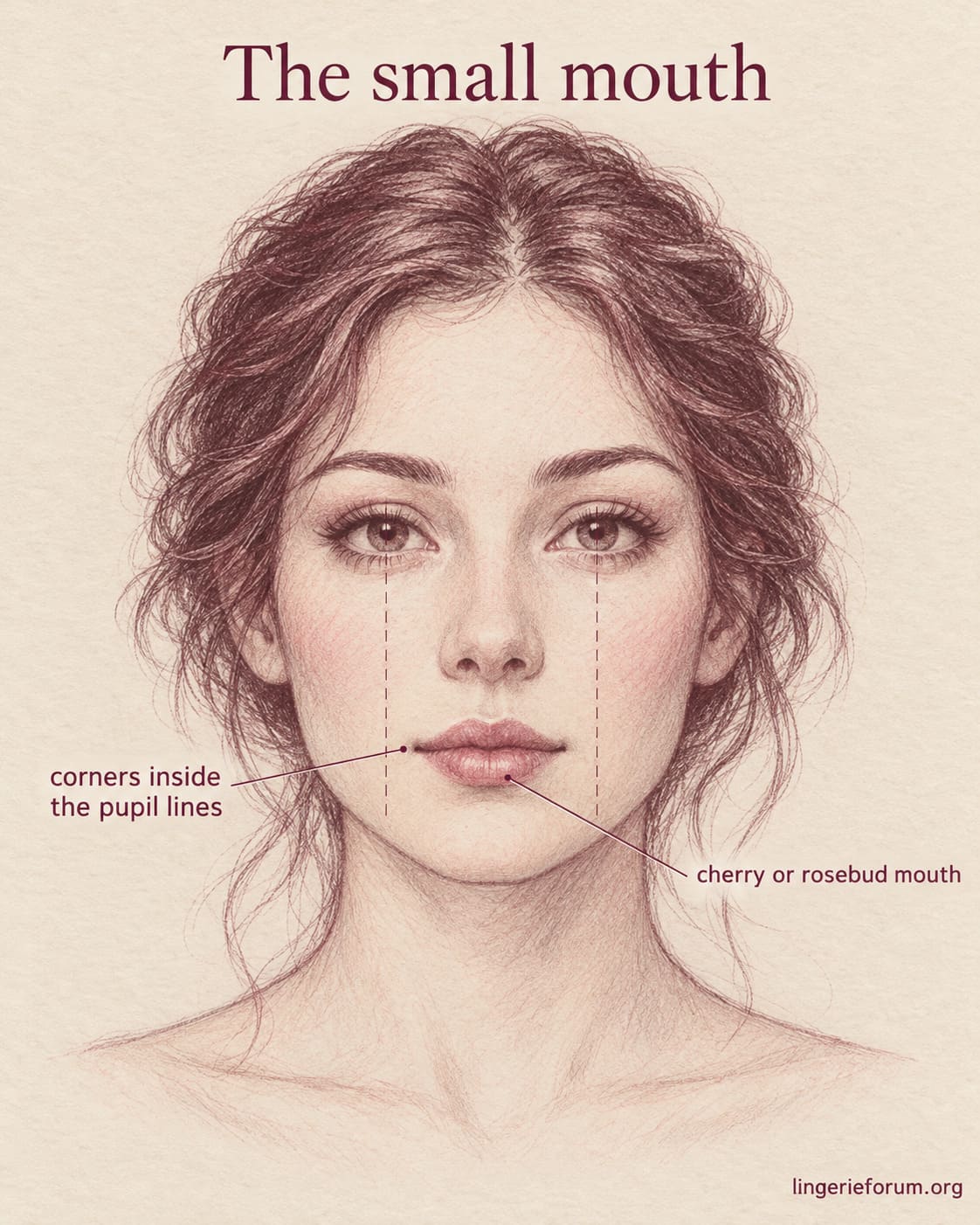
From the front, the mouth is narrow relative to the face, with the corners well in from the pupils. The lips may be full and rounded, which makes the mouth look like a small bloom, or they may be thinner. The cupid's bow is often clearly defined.
How do I know if I have a small mouth?
Relax your face, lips together, and look straight into a mirror or a level camera. Imagine a line dropped from the centre of each pupil. If your corners sit well inside those lines, your mouth is on the small side. Measure against your own face, not anybody else's: proportion is the only thing being described.
Why is a mouth small?
Mostly because of the teeth and jaw. Researchers who reconstruct faces from skulls found that the distance between the upper canine teeth was the best predictor of mouth width among the methods they tested: utilizing maxillary inter-canine width to estimate mouth width performed best. A smaller mouth usually sits in front of a narrower arch of teeth.
It also shifts with age: a 3D study found lip width increased and the height of the red of the lips decreased over the decades. For lip fullness and the cupid's bow themselves, see Lip Shapes Explained.
Why is the folklore about small mouths so contradictory?
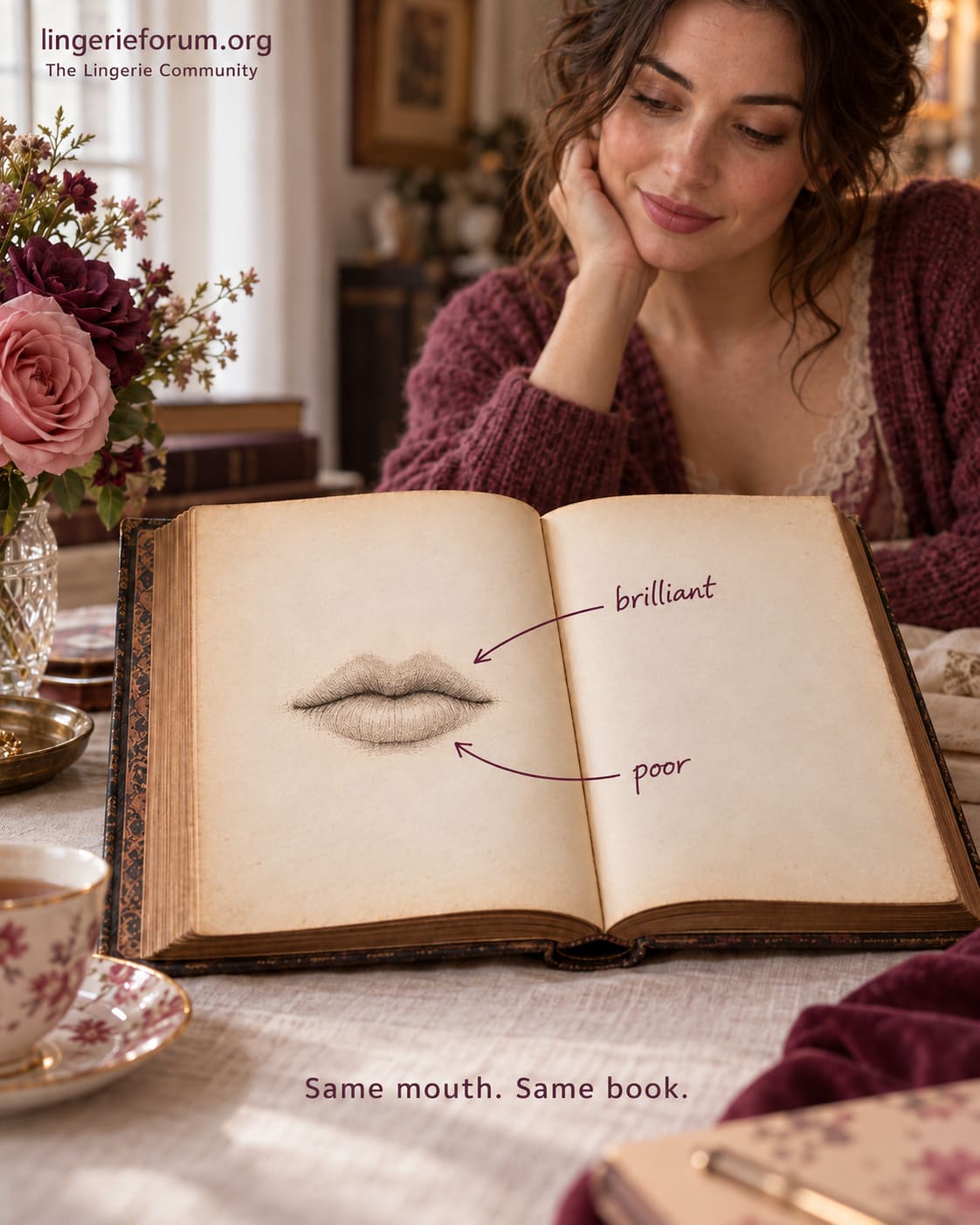
Because it was never a system, only a collection of sayings. The clearest example is in the classical text itself.
What does face reading say about a small mouth?
What the folklore says. Three traditions describe mouths, and they rarely agree. Ma Yi Xiang Fa, a classical Chinese face-reading text traditionally credited to a legendary figure known as the Hemp-Robed Daoist, names sixteen mouths and gives each a verdict about fortune. Johann Caspar Lavater's Essays on Physiognomy, published in German in the 1770s and quoted here from Thomas Holcroft's English translation, reads character from lips and corners. Samuel R. Wells's New Physiognomy, from 1866, does the same with the confidence of its century. Modern face-reading pages mix all three, usually without saying so.
Ma Yi Xiang Fa praises the cherry mouth: small, with lips like rouge and teeth close and even like pomegranate seeds, smiling as if with feeling, and destined for brilliance and high office. Modern Chinese pages turn that into "a small mouth with big ambitions" and call it strong-willed. Japanese face-reading pages call the small mouth calm and reserved.
Then the same classical text, a few lines away, names a different small mouth as a sign of poverty, and its prose says a mouth that is small and short means the same. Lavater, meanwhile, writes of a small narrow mouth as timid, and Russian pages call it weak. We have left the harsher versions out, but the point stands on its own: brilliant, ambitious, calm, timid and poor have all been read from the same small mouth, sometimes on the same page.
Is any of that true?
No. No study we could find has tested any named mouth type, in any tradition. What researchers have studied is the wider claim that faces reveal character, and the answer is consistent. A review from Alexander Todorov's lab at Princeton concluded that the diagnostic validity of these attributions has been greatly overstated. A 2022 meta-analysis of whether people can judge trustworthiness from a face found accuracy that was real but small, and unlikely to be of practical utility.
It is also worth knowing that the classical Chinese verses were never about personality. They predicted fortune: wealth, rank, how long you would live. The personality readings on modern pages are a later layer with no named author. Read the box above as history, and as a little fun, but not as a description of you.
The short version
Corners well inside the line from the pupils, often with full, rounded lips. Width follows the teeth. The folklore calls the small mouth brilliant and poor in the same book, which is the best evidence there is that it describes nobody.
Sources
- Houlton, Jooste and Steyn 2020, Mouth width and cupid's bow estimation - read as an abstract.
- Yang et al. 2023, Gender- and age-related characterization of lip morphology - read as an abstract.
- Todorov et al. 2015, Social attributions from faces - the accuracy of reading character from faces, read as an abstract.
- Foo et al. 2022, Accuracy in facial trustworthiness impressions: a meta-analysis - read as an abstract.
- Ma Yi Xiang Fa, section on the mouth (Chinese) - the sixteen classical mouths.
- Lavater, Essays on Physiognomy, Holcroft translation - "The Mouth and Lips".
- Wells, New Physiognomy (1866) - chapter XI, on the mouth.
Comments
Loading comments...