The Inverted Triangle Body Shape: Shoulders First, and Its Folklore
The inverted triangle has shoulders and bust broader than the hips, with a softer waist and slim legs. What it is, what fits it, and its folklore: the talented, hard-working Wood type of Chinese medicine, and the energetic muscular type of Kretschmer and Sheldon, plus a naming muddle to watch out for.
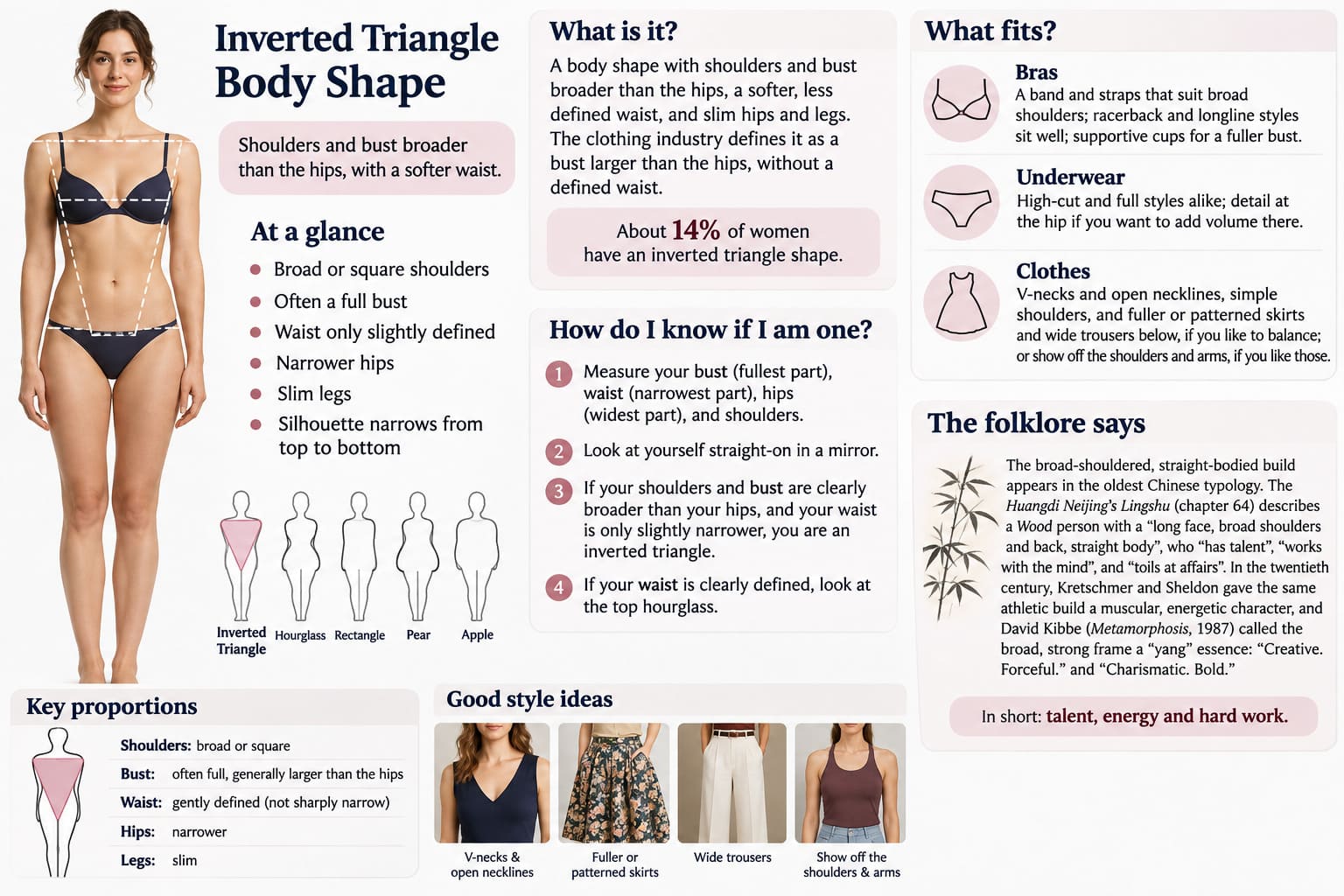
The inverted triangle body shape has shoulders and bust broader than the hips, a softer, less defined waist, and slim hips and legs, so the silhouette narrows from top to bottom. The clothing industry defines it as a bust larger than the hips, without a defined waist. A North Carolina State University study found just under 14% inverted triangle. Swimmers, rowers and plenty of women who have never done either share it.
What is an inverted triangle body shape?
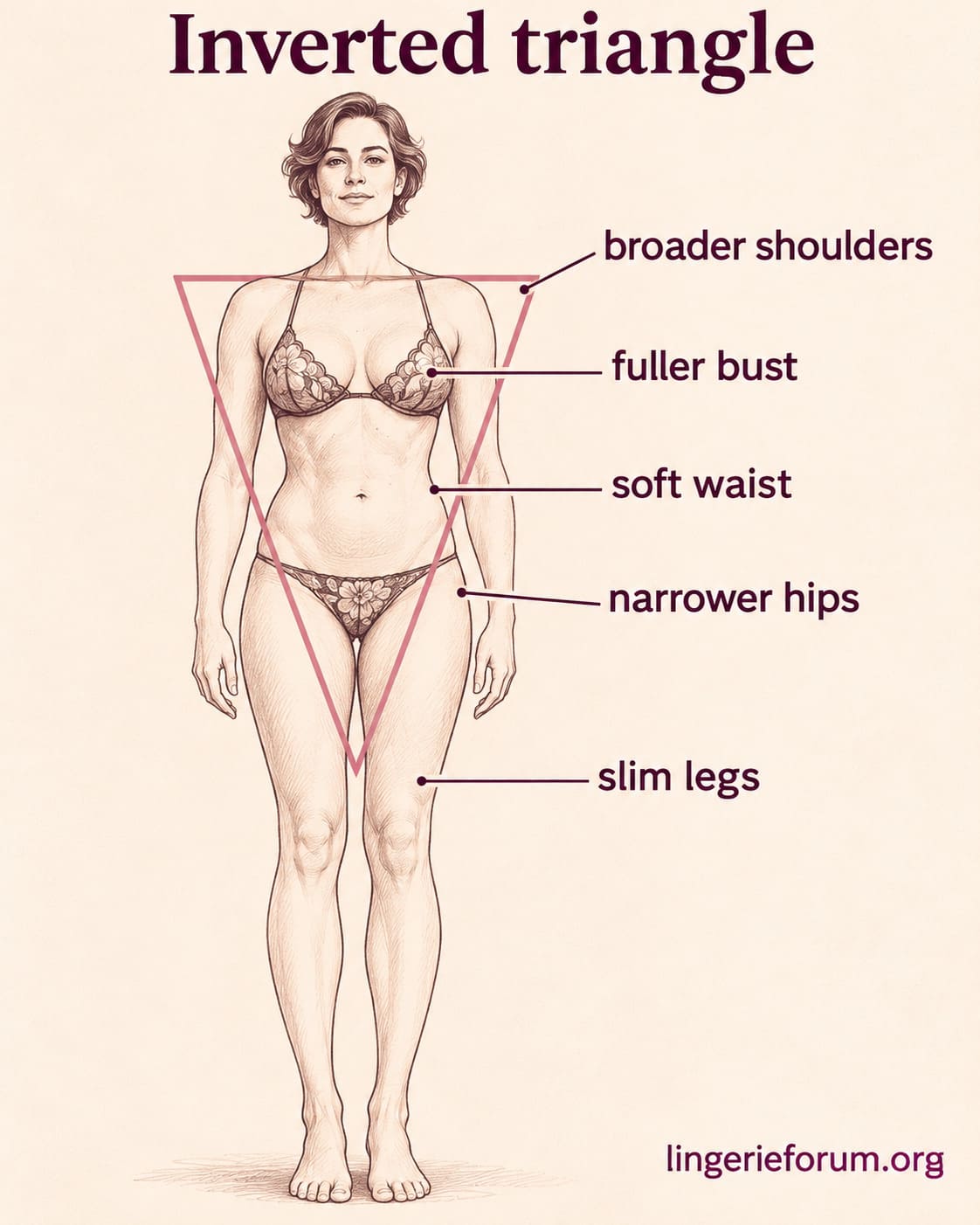
Broad or square shoulders, often a full bust, a waist only slightly defined, and narrower hips with slim legs. One naming muddle to know about: some websites call this shape "apple". On this site, apple means fullness through the middle, and the inverted triangle is the shoulders-first shape.
How do I know if I am an inverted triangle?
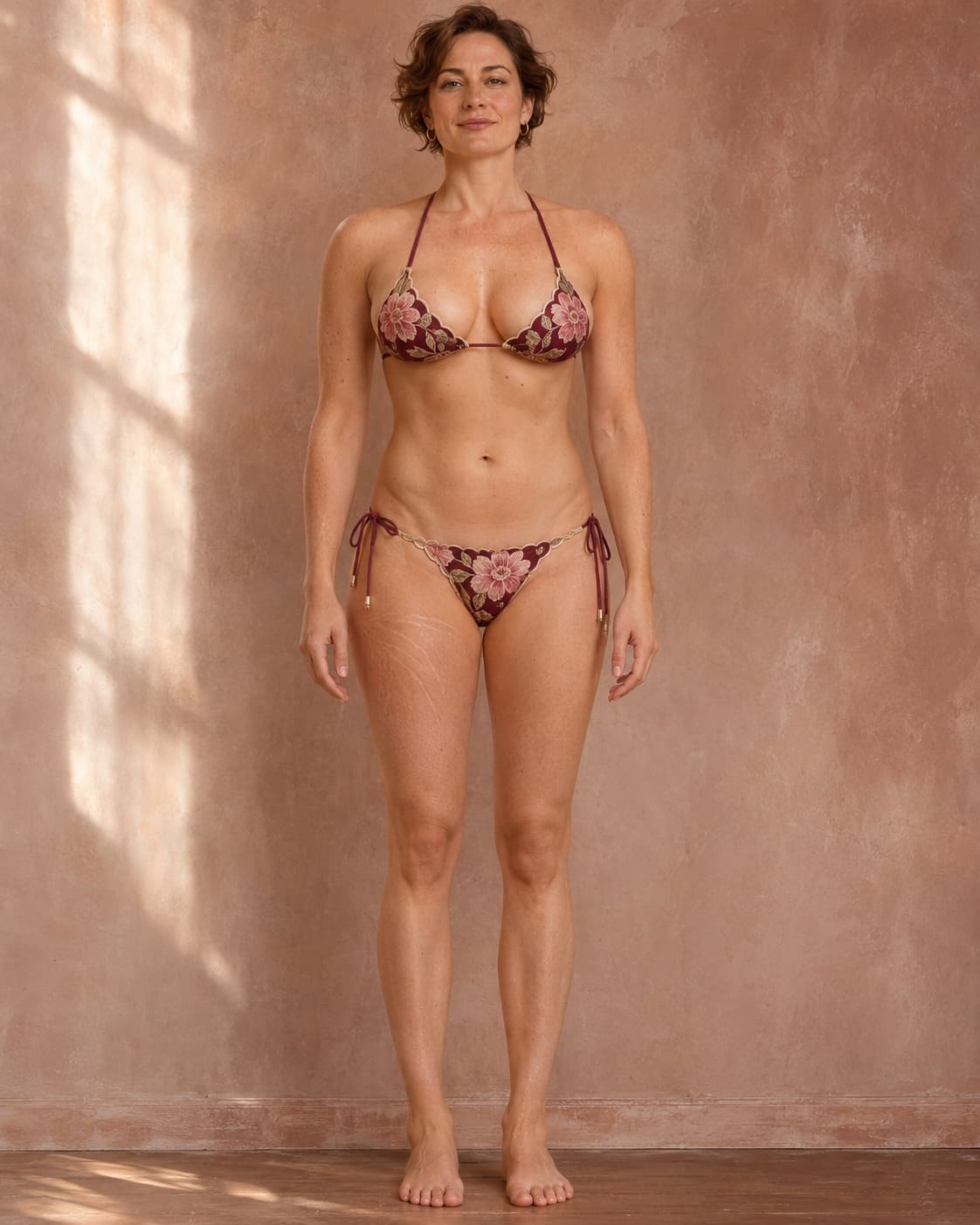
Measure around the fullest part of your bust, the narrowest part of your waist, and the widest part of your hips, and look at yourself straight-on in a mirror. The body shape calculator does the arithmetic. Most women land between two shapes, and the numbers move with weight, age, pregnancy and the time of the month, so read the answer as a description of now. Measure your shoulders too. If your shoulders and bust are clearly broader than your hips, and your waist is only slightly narrower, you are an inverted triangle. If your waist is clearly defined, look at the top hourglass.
What fits an inverted triangle body shape?
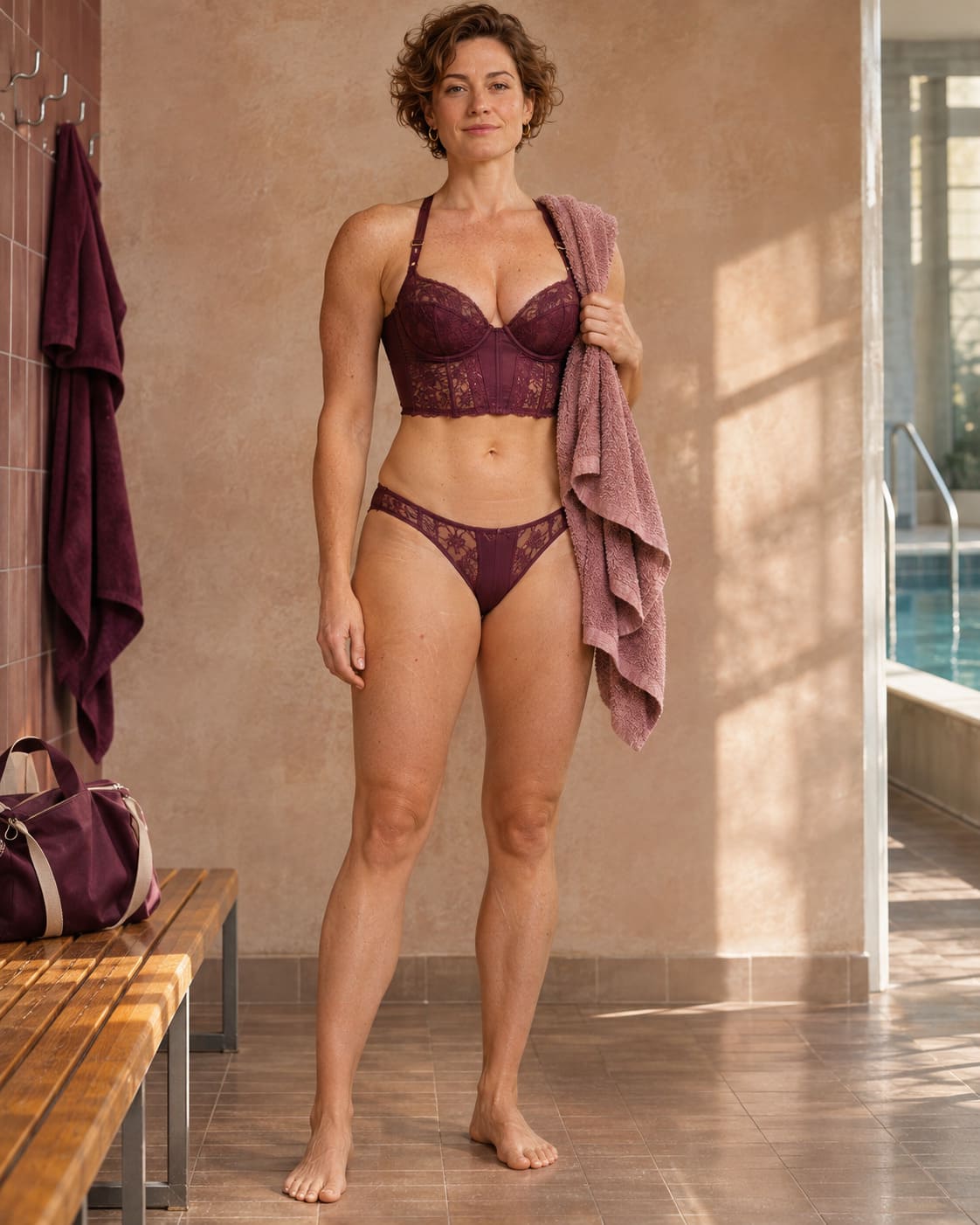
- Bras: a band and straps that suit broad shoulders; racerback and longline styles sit well; supportive cups for a fuller bust.
- Underwear: high-cut and full styles alike; detail at the hip if you want to add volume there.
- Clothes: V-necks and open necklines, simple shoulders, and fuller or patterned skirts and wide trousers below, if you like to balance; or show off the shoulders and arms, if you like those.
For the full guide, see 10 Women's Body Shapes Explained.
What does the folklore say about inverted triangle women?
What the folklore says. The broad-shouldered, straight-bodied build appears in the oldest Chinese typology. The Huangdi Neijing's Lingshu, chapter 64 (Huangdi Neijing, Lingshu, chapter 64), describes a Wood person with a "long face, broad shoulders and back, straight body", who "has talent", "works with the mind", and "toils at affairs" (our literal rendering). In the twentieth century, Kretschmer described his "athletic" build as having "particularly wide projecting shoulders" and "a trunk which tapers in its lower region"; Sheldon's version of the same muscular build came with "The Energetic Characteristic" and "vigor and push". And David Kibbe's styling book Metamorphosis (1987) gave the broad, strong frame a "yang" essence: "Creative. Forceful." and "Charismatic. Bold."
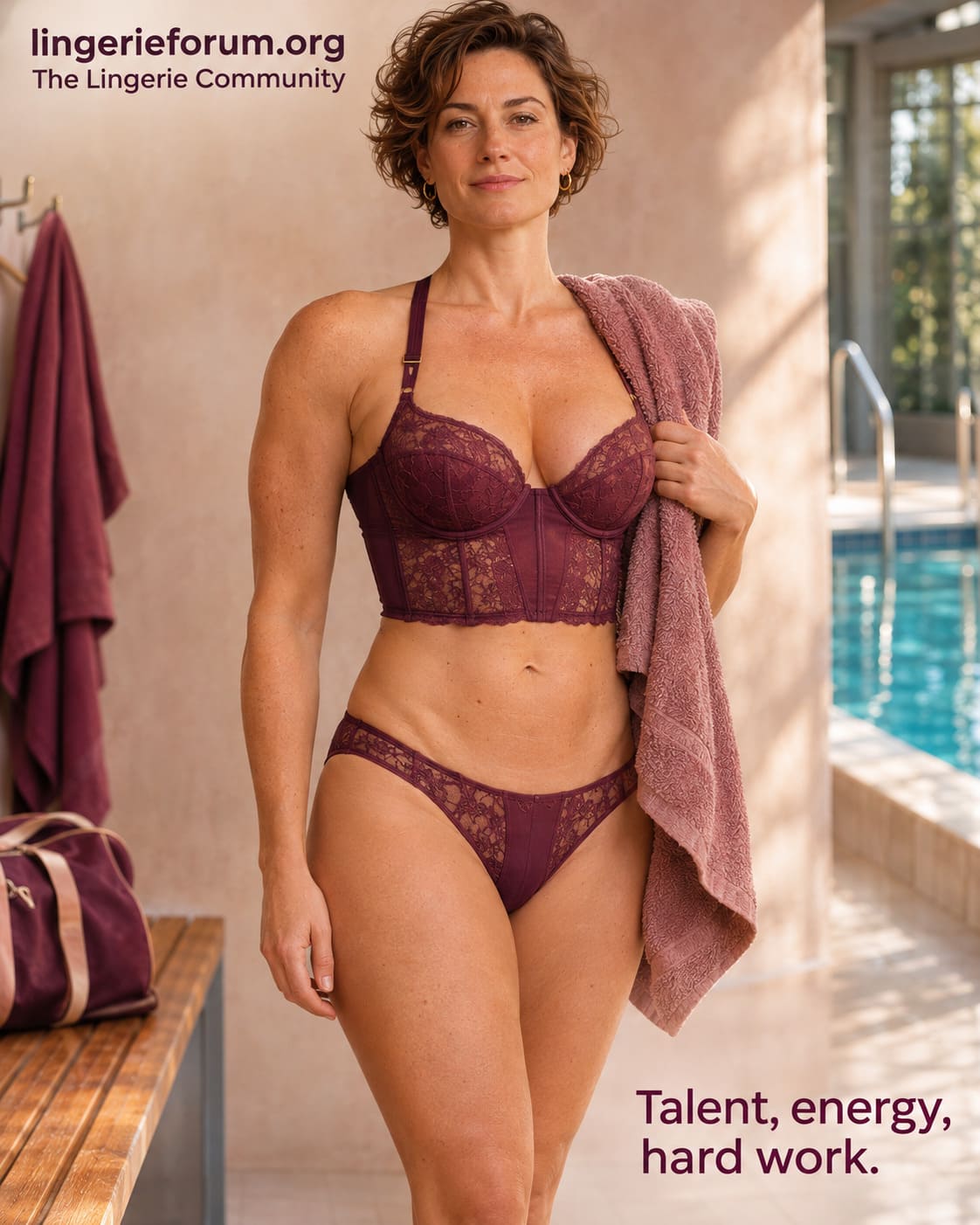
We have left out the old books' warnings about worry and dominance. What remains is a portrait of talent, energy and hard work.
Is any of that true?
No. No study has shown that a body's silhouette predicts character, and the research that exists points the other way: it shows how readily people pin traits onto bodies. One study found that people evaluate bodies on valence and agency and read personality into body shape consistently, which measures the viewers' agreement, not the truth. Another, with Nigerian schoolchildren, put it perfectly: the children attributed positive character traits to their perceived somatotypes and undesirable traits to the physiques with which they were dissatisfied. The traits followed the feelings, not the bodies. Tests of Sheldon's own claims found no significant associations between somatotype and temperament. Enjoy the box above as history, and as fun.
The short version
Shoulders and bust broader than the hips, a soft waist, slim legs; not the same as "apple", whatever some sites say. Racerbacks and balance below, or none. The folklore calls this build talented, energetic and hard-working.
Sources
- Wikipedia, Female body shape - the NC State study.
- Huangdi Neijing, Lingshu chapter 64 (Chinese, Wikisource) - the Wood person; the English is our literal rendering.
- Ernst Kretschmer, Physique and Character, English translation 1925 - chapter II.
- William Sheldon, The Varieties of Temperament, 1942
- David Kibbe, Metamorphosis (Atheneum, 1987).
- Hu et al. 2018, First impressions of personality traits from body shapes - read as an abstract.
- Salokun and Toriola 1985, perceived somatotypes and character traits - read as an abstract.
- Catell and Metzner 1993, somatotype, temperament and self-actualization - read as an abstract.
Comments
Loading comments...