The Apple Body Shape: Round, Soft, and What the Old Books Say
The apple, also called round or oval, carries its fullness through the middle, with slimmer legs. What the shape is, how to tell, what fits it, and the richest personality folklore of any body shape: Kretschmer's sunny, sociable pyknic type, Ayurveda's strong and calm kapha, and the Chinese Earth type who likes to help others.
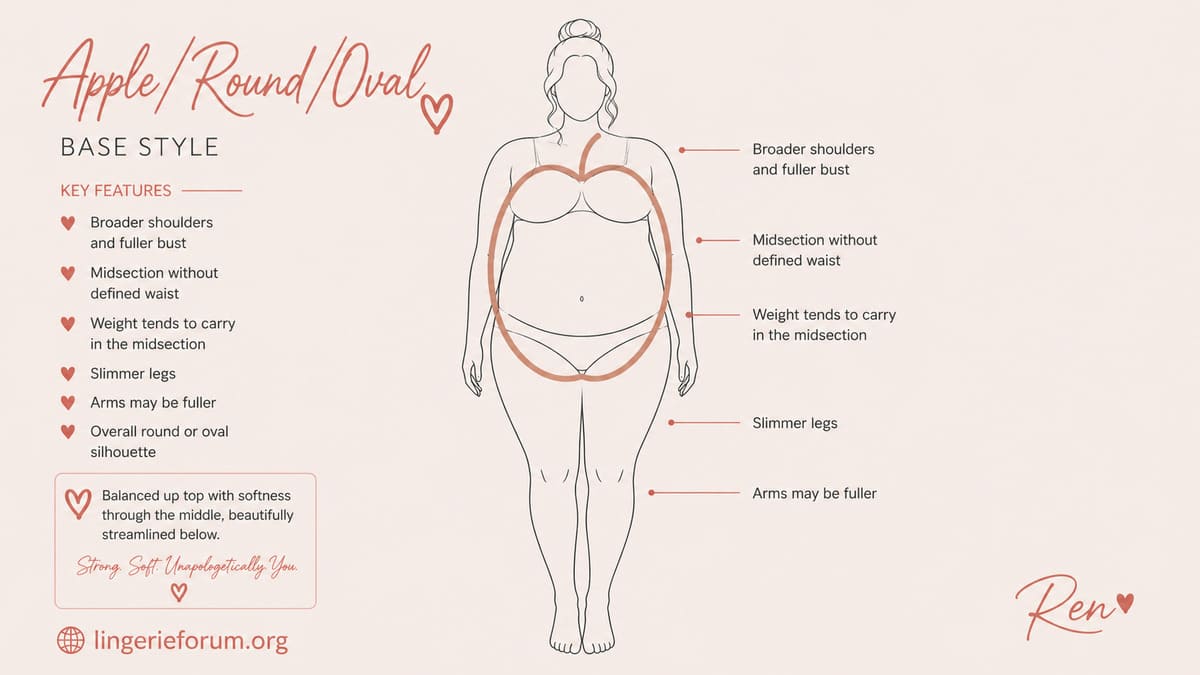
The apple body shape, also called round or oval, carries its fullness through the midsection, with a fuller bust, a waist that is not narrower than the bust or hips, and legs that are often slimmer. The name comes from medical writing: a 1988 study of 44,820 women described gynoid (pear shape), intermediate, and android (apple shape) bodies, and fashion took the fruit and kept it. It also has more personality folklore attached to it than any other shape.
What is an apple body shape?
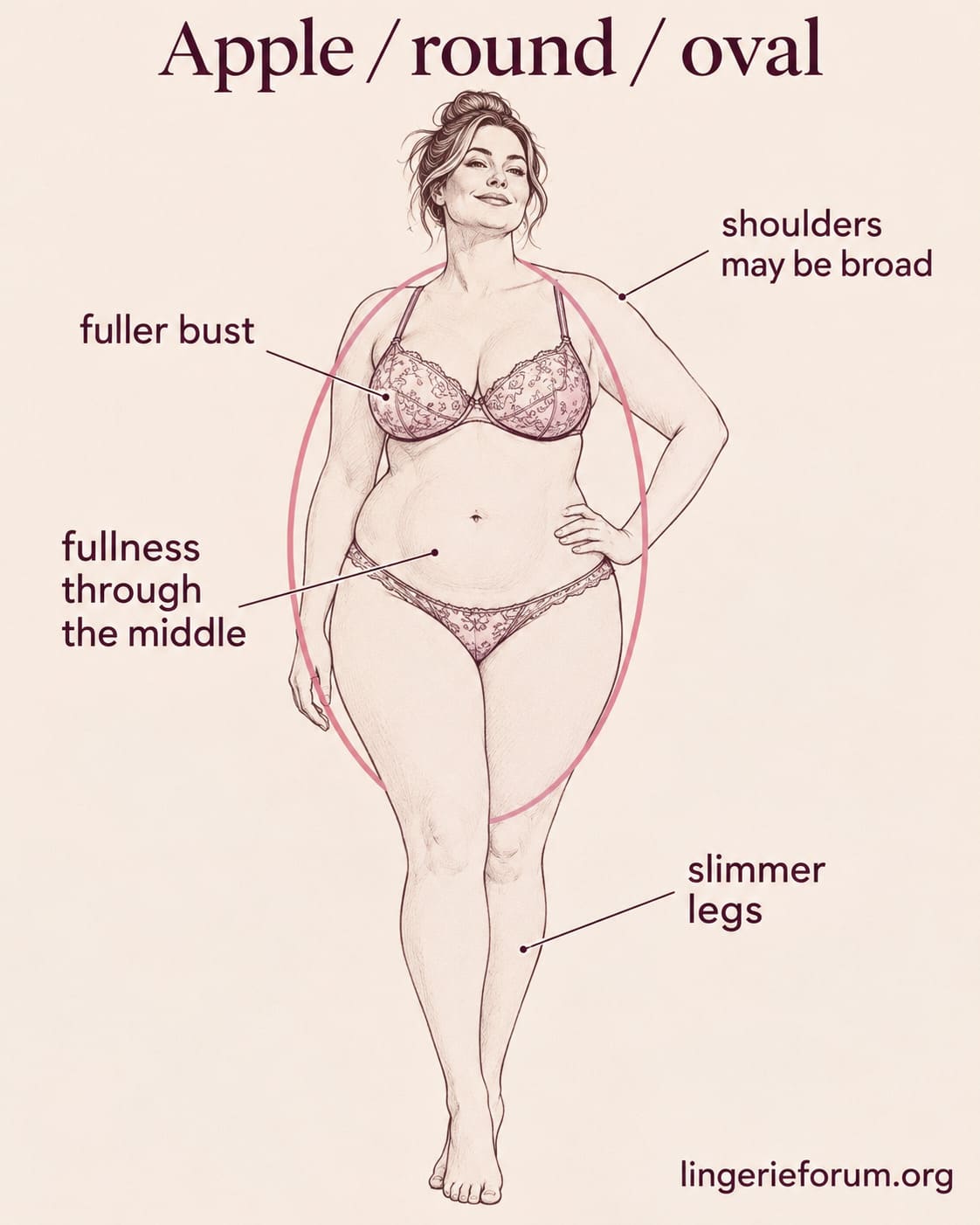
Fullness sits around the middle: the bust is usually full, the waist is the widest or nearly the widest measurement, and the hips and legs are comparatively slim. Shoulders are often broad. Clothing researchers call the same shape "oval". It comes in every size.
How do I know if I am an apple?
Measure around the fullest part of your bust, the narrowest part of your waist, and the widest part of your hips, and look at yourself straight-on in a mirror. The body shape calculator does the arithmetic. Most women land between two shapes, and the numbers move with weight, age, pregnancy and the time of the month, so read the answer as a description of now. If your waist measures close to or more than your bust and hips, and your legs are the slimmest part of you, you are in apple territory. The nearest neighbour is the diamond, which is fuller through the middle too but with a smaller bust and wider hips.

What fits an apple body shape?
Look for garments that give room through the middle and put structure where you have definition, usually the bust, shoulders and legs.
- Bras: a firm band and full cups for a fuller bust; the bra fitting guide helps.
- Bodysuits and slips with stretch through the torso move with you.
- Underwear: high-rise styles that sit smoothly above or below the tummy rather than across it; which you prefer is personal.
- Clothes: wrap and empire lines, V-necks and open collars, structured shoulders, and anything that shows off your legs if you like them.
For the full styling guide, see 10 Women's Body Shapes Explained.
What does the folklore say about apple-shaped women?
What the folklore says. The apple shape inherits the round, full constitution that almost every old system described, and most of them liked it. The German psychiatrist Ernst Kretschmer, in Physique and Character (1921; English 1925), called the rounded "pyknic" build cyclothymic, and wrote of its people: "good-heartedness, sunny-friendliness, easy to get on with in company, sociable", "born story-tellers", "firm friends" who "live and let live". The Charaka Samhita, the classic text of Ayurveda, says the full, "compact and stable" kapha person is "strong, wealthy, learned, brave, calm and long lived" (Charaka Samhita, Vimana Sthana 8). William Sheldon's endomorph was defined by "love of comfort, sociability". And a modern personality test in a 2023 Minds Journal personality test gives apple women "confidence, charisma, and a warm, nurturing nature" and "strong leadership qualities".
Two honest notes. Kretschmer and Sheldon built their types from men, and the old books were not describing fashion shapes, so this is a loose fit. And some of them were unkind to round bodies in lines we have left out. What remains is remarkably consistent: sunny, sociable, calm, loyal, warm.
Is any of that true?
No. No study has shown that a body's silhouette predicts character, and the research that exists points the other way: it shows how readily people pin traits onto bodies. One study found that people evaluate bodies on valence and agency and read personality into body shape consistently, which measures the viewers' agreement, not the truth. Another, with Nigerian schoolchildren, put it perfectly: the children attributed positive character traits to their perceived somatotypes and undesirable traits to the physiques with which they were dissatisfied. The traits followed the feelings, not the bodies. Tests of Sheldon's own claims found no significant associations between somatotype and temperament. Enjoy the box above as history, and as fun.
The short version
Fullness through the middle, a full bust, slimmer legs. Garments that give room at the waist and structure at the bust and shoulders. The folklore, from 1920s Germany to ancient India, calls apples sunny, sociable, calm and loyal; no study has ever tested it.
Sources
- Rimm, Hartz and Fischer 1988, A weight shape index in 44,820 women - where "apple" and "pear" enter print, read as an abstract.
- Ernst Kretschmer, Physique and Character, English translation 1925 - chapter XII.
- William Sheldon, The Varieties of Temperament, 1942
- Charaka Samhita, Vimana Sthana 8.96
- Irina Hope, Body Shape Personality Test, The Minds Journal, 2023
- Hu et al. 2018, First impressions of personality traits from body shapes - read as an abstract.
- Salokun and Toriola 1985, perceived somatotypes and character traits - read as an abstract.
- Catell and Metzner 1993, somatotype, temperament and self-actualization - read as an abstract.
Comments
Loading comments...