Round Lips and a Soft or No Cupid's Bow: What It Means
Round lips have a gently curved upper edge with a soft cupid's bow, or none at all: the rosebud or doll shape. What the shape is, why a soft bow is a preference many people share, how every bow softens with age, and what face reading claims, from the classical Chinese cherry mouth to modern pages that call round lips kind, reliable and generous.
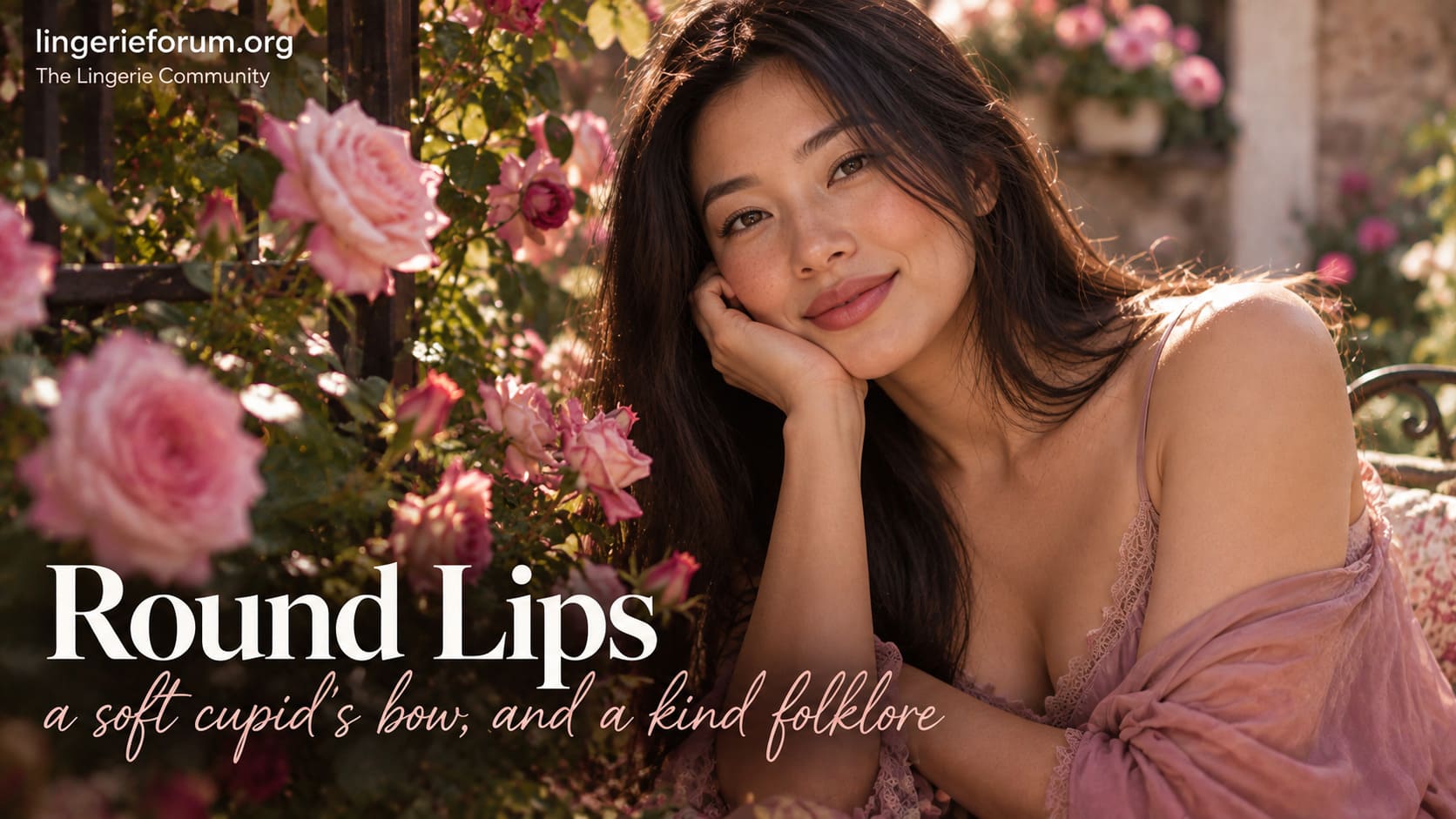
Round lips have a gently curved upper edge with a soft cupid's bow, or no visible bow at all, so the mouth reads as smooth and rounded rather than peaked. English has long called a small version a rosebud mouth; modern pages say doll lips. It is an ordinary shape with a pleasant folklore: of all the lip shapes, this is the one the readers are kindest about.
What do round lips look like?
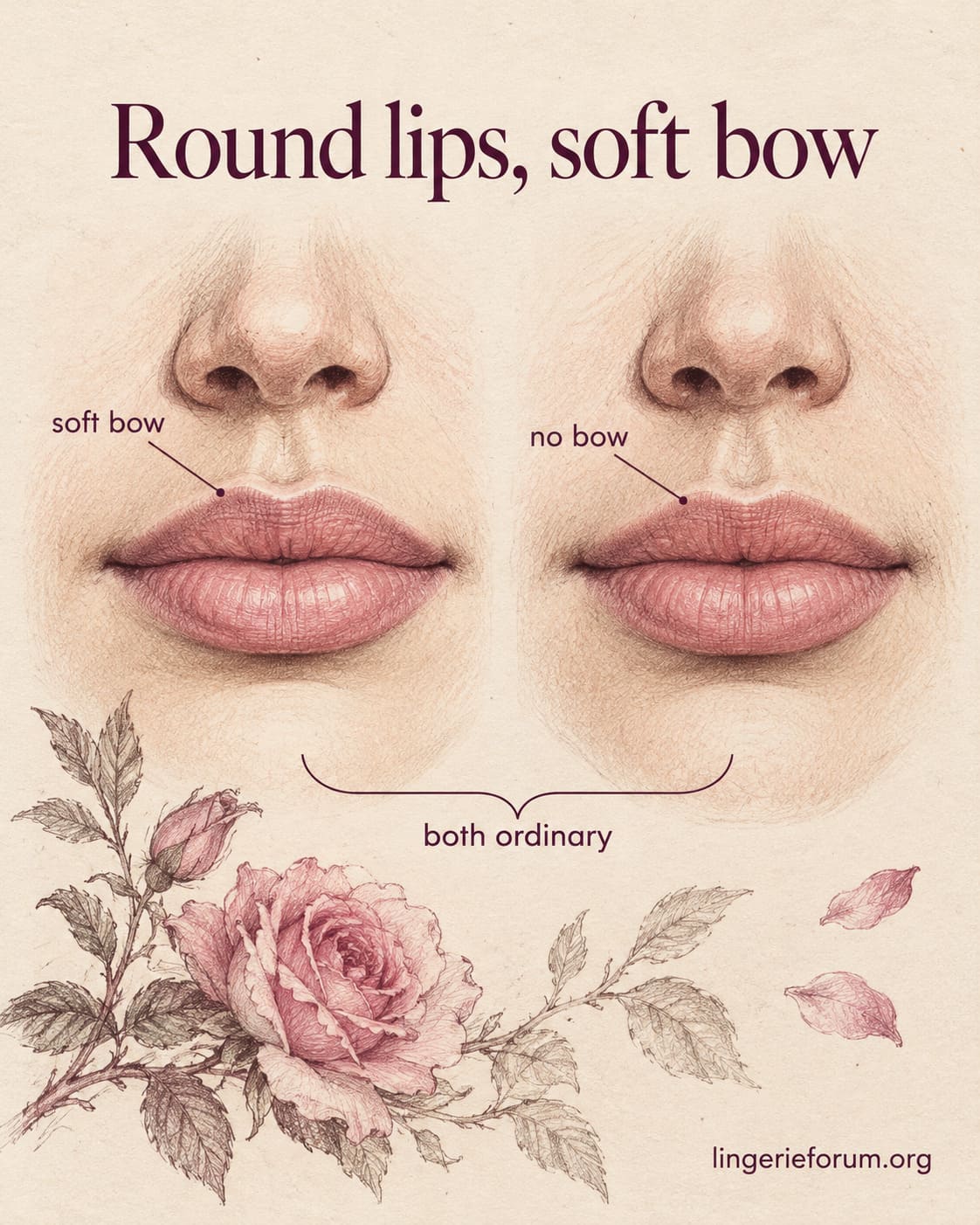
From the front, the top edge of the upper lip curves smoothly instead of rising to two sharp peaks. The lower lip is often full and rounded. The mouth may be small or wide; the softness of the bow is the defining feature.

How do I know if I have round lips?
Relax your face, lips gently together, and look straight into a mirror at eye level, or take a photo with the camera level with your mouth. No lipstick, no pout, no smile: the shape at rest is the one every tradition reads. Look at the top edge of the upper lip. A gentle single curve, a faint wave, or an almost straight line means a soft bow. Two distinct peaks with a dip mean a defined bow, which has its own article in this series.
Is a soft cupid's bow less attractive?
That depends entirely on who is looking. One study found women were 2.42 times more likely than men to prefer no Cupid's indentation on a female model. A study of what raters in China found most attractive picked a flat upper vermilion border, meaning almost no bow, and roughly equal upper and lower lips. And a cross-cultural study found that country of residence, ethnic background, and profession significantly impact individual lip shape preferences. There is no single ideal to fall short of.
Does a cupid's bow change with age?
Every bow softens. In a 3D study of adult lips, angles related to cupid's bow significantly increased with age, meaning bows flatten over time. Round lips are where many sharper bows eventually arrive.
What does face reading say about round lips?
What the folklore says. Four sources account for almost everything said about lips and character. Shen Xiang Quan Bian, a Ming-dynasty Chinese face-reading compilation traditionally credited to the sage Chen Tuan, opens its section on lips by calling them the city wall of the mouth and the gate of the tongue. Johann Caspar Lavater's Essays on Physiognomy (1770s, quoted from Thomas Holcroft's English translation) declares "As are the lips so is the character". Samuel R. Wells's New Physiognomy (1866) reads love and affection in them. And most of what modern pages say, especially about the cupid's bow, traces to the American face reader Jean Haner, whose views are quoted here from an interview about her book The Wisdom of Your Face.
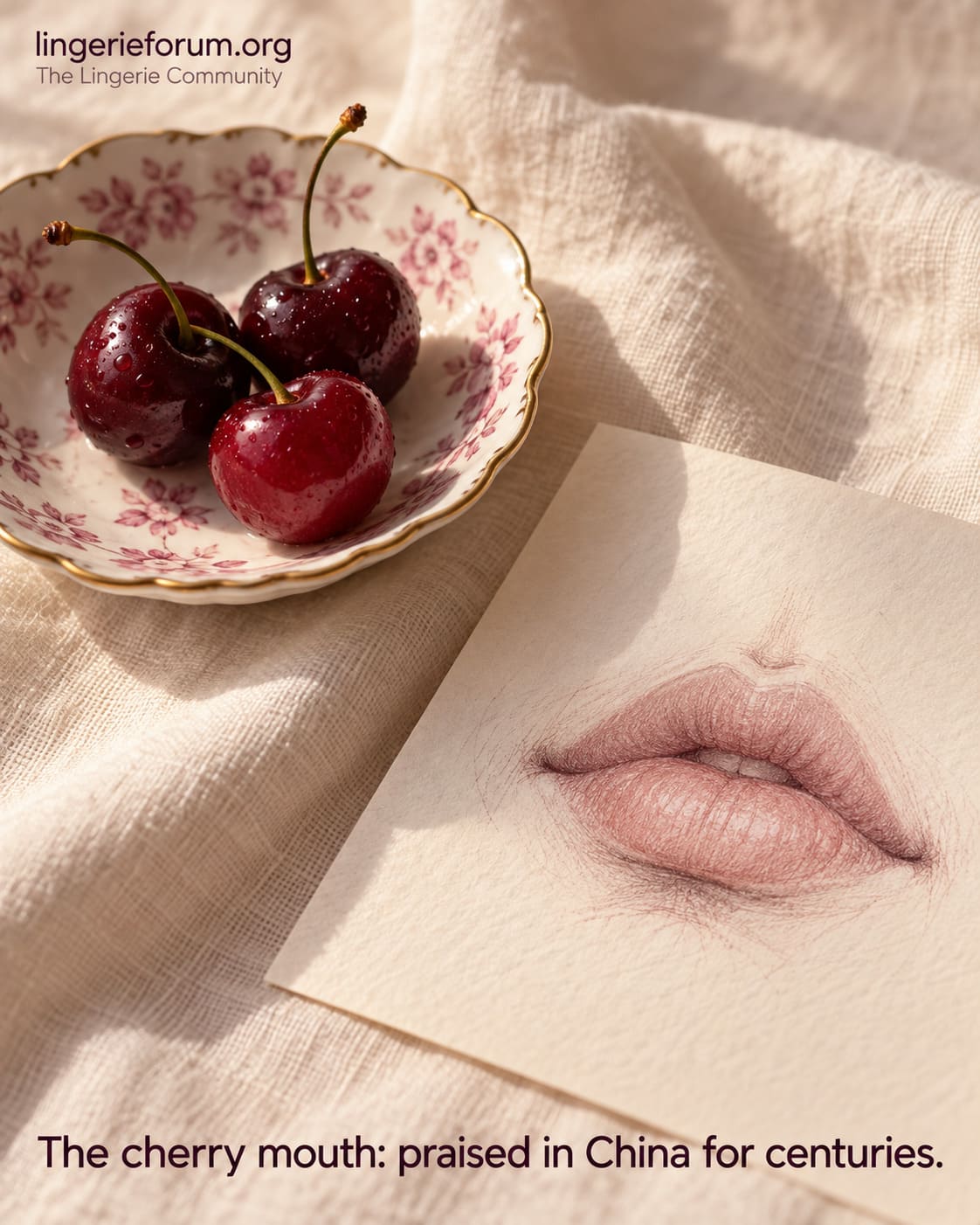
The classical Chinese texts praise the cherry mouth, with rouge-red lips and teeth like pomegranate seeds, and promise its owner cleverness and high office. Jean Haner reads a rounded bow as extra kind. Other modern pages call round, soft lips compassionate, generous, responsible and reliable, a devoted friend.
Haner reads a bow that is barely there as someone who gives so much that her own limits blur; another page reads the same shape as simply very generous. We prefer the second, and so, it seems, does most of the folklore.
Is any of that true?
No. We found no study that has tested lip shape against measured personality, in any direction. Research on the wider idea, reading character from faces, finds that people agree quickly and are mostly wrong: a review from Alexander Todorov's lab concluded that the diagnostic validity of these attributions has been greatly overstated.

One study shows neatly what lips really change. Strangers rated before-and-after photos of women who had lip filler, and rated the after photos significantly improved compared to the pre-treatment photographs across all nine trait domains, including trustworthiness and intelligence. The women had not changed. The strangers' guesses had. That is what face reading measures: the reader. Enjoy the box above as history, and as a little fun.
The short version
A smooth, rounded upper edge with a soft bow or none. Many people prefer it, every bow softens with age, and the folklore calls it kind, generous and reliable. Nice to read; never tested.
Sources
- Kempa et al. 2024, lip aesthetic preferences - read as an abstract.
- Yang et al. 2024, The ideal Chinese lip - read as an abstract.
- Heidekrueger et al. 2017, Lip attractiveness: a cross-cultural analysis - read as an abstract.
- Yang et al. 2023, Gender- and age-related characterization of lip morphology - read as an abstract.
- Todorov et al. 2015, Social attributions from faces - read as an abstract.
- Othman et al. 2021, The impact of dermal fillers on perceived personality traits - read as an abstract.
- Shen Xiang Quan Bian, section on lips (Chinese, Wikisource)
- Lavater, Essays on Physiognomy, Holcroft translation - "The Mouth and Lips".
- Wells, New Physiognomy (1866) - chapter XI.
- Jean Haner, interviewed in Cosmopolitan India
Comments
Loading comments...